How to Protect Your Lungs from Wildfire Smoke: Air Quality Tips That Work
Wildfire smoke reaches far beyond the flames. Learn its health effects, how to read the AQI, which masks actually work, and how to keep the air in your home clean.
A wildfire's footprint is much bigger than its burn scar. Smoke can travel hundreds or even thousands of miles, turning skies orange in cities far from any flames, and it affects far more people than the fire itself. Understanding wildfire smoke health effects, and the simple steps that reduce them, is one of the most useful things you can do during fire season. This guide explains what is in smoke, how to read the Air Quality Index (AQI), which masks actually work, and how to keep the air inside your home clean.
Key takeaways
- The main health threat in smoke is PM2.5, fine particles small enough to reach deep into the lungs and the bloodstream.
- Check the AQI before going outside. At 101 and above, sensitive groups should cut back outdoor activity; at 151 and above, everyone should.
- A well-fitted N95 respirator filters smoke particles. Cloth masks, surgical masks and bandanas don't.
- Indoors, a HEPA air purifier or a DIY box-fan filter can cut indoor particle levels sharply.
- Children, older adults, pregnant people and anyone with heart or lung disease need extra protection.
What's in wildfire smoke?
Wildfire smoke is a mixture of gases (including carbon monoxide), volatile organic compounds and particles. When forests burn into neighborhoods, it also carries the residue of burned plastics, building materials and vehicles. The component of greatest concern is fine particulate matter, or PM2.5: particles 2.5 micrometers across or smaller, roughly 30 times thinner than a human hair. They are small enough to slip past the nose and throat, lodge deep in the lungs, and in some cases pass into the bloodstream.
Wildfire smoke health effects and symptoms
Even healthy adults can feel the effects of smoke on a bad day. Common symptoms include:
- Burning eyes, a runny nose and a scratchy throat
- Coughing, phlegm and wheezing
- Headaches and fatigue
- Shortness of breath or chest tightness
- A fast heartbeat
For people with asthma or COPD, smoke can trigger attacks and flare-ups. For people with heart disease, fine particles raise the risk of heart attacks, irregular heartbeat and strokes. Researchers are also studying the longer-term effects of repeated smoke seasons on the lungs and heart.
Get medical help right away (call 911) for chest pain, severe shortness of breath, or symptoms that worsen quickly. If you have a chronic condition, ask your doctor for a smoke plan before fire season begins, including when to adjust medications.
How to read the Air Quality Index (AQI)
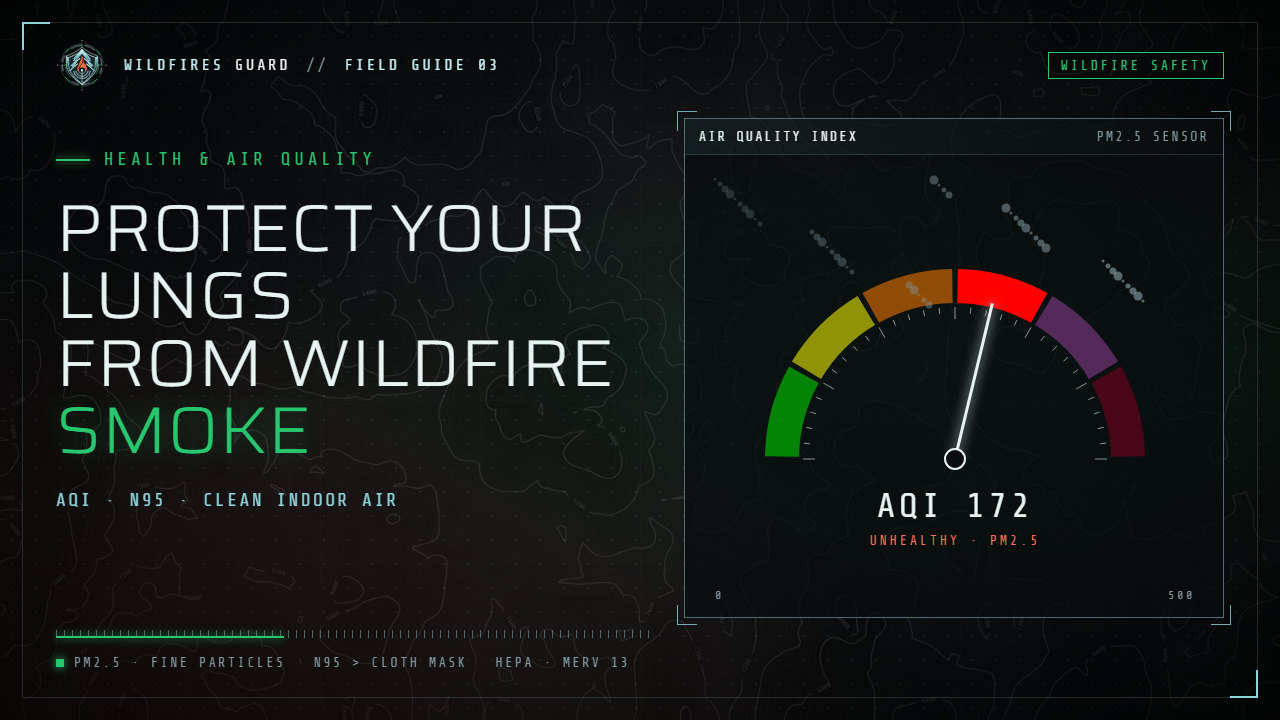
The Air Quality Index translates pollution measurements into a single number from 0 to 500, with color-coded categories. During wildfires, PM2.5 usually drives the AQI.
| AQI | Category | What to do |
|---|---|---|
| 0–50 | Good (green) | Enjoy normal activities. |
| 51–100 | Moderate (yellow) | Unusually sensitive people should consider limiting long or heavy exertion outdoors. |
| 101–150 | Unhealthy for sensitive groups (orange) | Sensitive groups should reduce outdoor exertion and watch for symptoms. |
| 151–200 | Unhealthy (red) | Everyone should reduce outdoor exertion; sensitive groups should avoid it. |
| 201–300 | Very unhealthy (purple) | Everyone should avoid prolonged outdoor exertion. Stay indoors with clean air if you can. |
| 301+ | Hazardous (maroon) | Everyone should avoid all outdoor activity. |
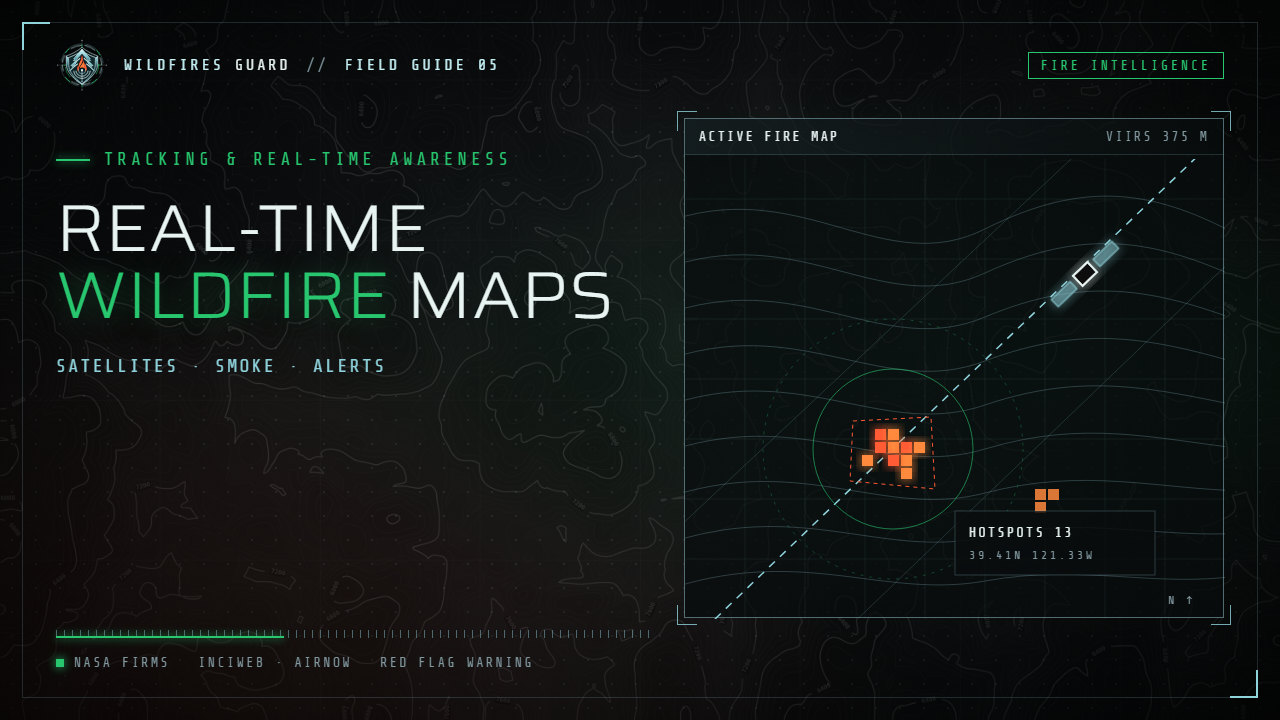
Smoke conditions change by the hour as the wind shifts, so check a current reading, not yesterday's forecast. The AirNow Fire and Smoke Map is the best wildfire air quality map for this: it combines official monitors, corrected data from low-cost sensors, satellite smoke plumes and active fire locations in one view. For more tools, see our roundup of real-time wildfire maps and trackers.
Your eyes are a rough backup. If smoke has cut daytime visibility to about 5 miles or less, the air is likely unhealthy for sensitive groups; below about 2 miles, it is unhealthy for everyone.
The best mask for wildfire smoke
Only a respirator that filters fine particles and seals to your face offers real protection.
- N95 respirators (NIOSH-approved) filter at least 95% of airborne particles when they fit well. P100 respirators filter more and are a good option too.
- Cloth masks, surgical masks, bandanas and wet towels don't filter the fine particles in smoke. They may stop larger ash, but give a false sense of security.
- Respirators don't filter gases such as carbon monoxide. They reduce your exposure to particles, not to everything in smoke.
How to wear an N95 correctly
- Choose one with two straps that go around your head, not ear loops.
- Pinch the metal nose strip to your nose, and check the seal: when you breathe out, air shouldn't leak around the edges.
- Facial hair under the seal stops it working.
- Replace it when it gets dirty, damaged or harder to breathe through.
Respirators make breathing harder. People with heart or lung disease should talk to their doctor before using one. N95s are not designed for young children, so the best protection for kids is staying indoors in clean air.
How to clean indoor air during a fire
Most people spend smoke events indoors, but smoke gets inside too. A few steps make a big difference:
- Seal the house. Close windows and doors, and close the fireplace damper. If it's hot, use air conditioning rather than opening windows.
- Upgrade your HVAC filter. If your central system can handle it, fit a MERV 13 or higher filter, set the system to recirculate, and run the fan continuously ("On", not "Auto") so air passes through the filter.
- Run a HEPA air purifier. Choose a portable unit sized for the room. A common rule from the appliance industry is a smoke CADR (clean air delivery rate) of at least two-thirds of the room's floor area: a 300 sq ft room needs a CADR of 200 or more.
- Create a clean room. If you can't filter the whole house, pick one room, often a bedroom, keep its windows and door closed, and run a purifier there around the clock.
- Don't add pollution. Avoid frying or broiling food, burning candles or incense, smoking, and vacuuming unless your vacuum has a HEPA filter.
- Avoid ozone generators. "Air purifiers" that work by producing ozone irritate the lungs and should not be used.
DIY box-fan air purifier
If HEPA purifiers sell out, a DIY air purifier works surprisingly well. Tape a 20-inch MERV 13 furnace filter to the intake side of a 20-inch box fan, with the airflow arrow pointing toward the fan. For more filtration, build a Corsi-Rosenthal box: four or five MERV 13 filters taped into a cube with a box fan on top, blowing out. Use a newer fan, and don't leave it running unattended or while you sleep.
In the car
Keep windows closed, and set the ventilation to recirculate. A clean cabin air filter helps.
Protecting children, seniors and other vulnerable groups
Some people face greater risk from the same smoke:
- Children breathe more air for their body weight, and their lungs are still developing. Move recess, sports and play indoors when the AQI is unhealthy.
- Older adults are more likely to have heart or lung disease. Check on older neighbors and relatives, especially those living alone.
- Pregnant people should limit their exposure, since smoke can affect both parent and baby.
- People with asthma, COPD or heart disease should keep medications on hand, follow their action plan, and leave the area if symptoms get worse.
- Outdoor workers need respirators and more breaks indoors, and employers in some states are required to provide them above certain AQI levels.
If indoor air in your home can't be kept clean, look for community clean-air centers such as libraries or cooling centers with good filtration.
After the smoke clears
When the AQI improves, open the windows to air the house out, and replace dirty HVAC and purifier filters. If ash has fallen on your property, dampen it before cleaning it up, wear an N95 and gloves, and don't use leaf blowers, which put fine ash back into the air.
Smoke seasons are getting longer as climate change drives larger and more frequent fires, so make smoke protection part of your wildfire preparedness checklist. Put N95s in every go-bag, and keep spare filters at home before fire season starts.
Smaller fires make less smoke. The WG Sentinel, now in development, is designed with an air-chemistry bay to sense PM2.5, carbon monoxide and volatile compounds. Together with cameras and thermal imaging, the aim is to catch fires in their first minutes, while they can still be stopped.
Frequently asked questions
Is wildfire smoke worse than regular air pollution?
Smoke events can produce some of the highest PM2.5 levels people ever breathe, many times higher than typical urban pollution, and studies suggest wildfire particles may be more harmful to the lungs than the same amount of other particle pollution. The good news is that the same protections work: stay indoors, filter the air, and wear an N95 outdoors.
Do surgical masks protect against wildfire smoke?
No. Surgical and cloth masks don't seal to the face and don't filter fine particles well. Use a well-fitted NIOSH-approved N95 or P100 respirator.
Do air purifiers work for wildfire smoke?
Yes. Portable HEPA purifiers sized for the room, MERV 13 filters in a central system, and DIY box-fan filters all significantly reduce indoor PM2.5 levels. Keep windows and doors closed so they aren't filtering outdoor air.
How long do wildfire smoke health effects last?
For most healthy people, symptoms such as coughing and irritated eyes ease within days of cleaner air. People with chronic conditions can take longer to recover, and should follow up with their doctor if symptoms persist.