Wildfires and Climate Change: Why Fire Seasons Are Getting Longer and More Intense
Hotter, drier fuels, megadrought and a century of fire suppression are making wildfires worse. Here is the science, and why prescribed burns are part of the solution.
Fire seasons that once lasted a few summer months now stretch across much of the year, and fires that would have been considered extreme a generation ago have become routine headlines. Why are wildfires getting worse? The answer is not a single cause but three forces acting together: a warming climate that dries out fuels, a century of fire suppression that let those fuels pile up, and more people living where forests and grasslands meet. This article explains the science linking climate change and wildfires, and why the solution includes, perhaps surprisingly, more fire of the right kind.
Key takeaways
- Warmer air pulls more moisture out of plants and soil, so fuels dry faster and stay dry longer.
- Fire seasons are getting longer: globally, the fire weather season grew by nearly 19% between 1979 and 2013.
- A century of putting out every fire left many Western forests overgrown with fuel.
- Many ecosystems depend on fire. Prescribed burns return low-intensity "good fire" to the landscape and reduce the risk of catastrophic "bad fire".
How climate change and wildfires are linked
Climate change doesn't light fires; people and lightning do. What a warmer climate changes is everything that happens after the spark: how readily fuels ignite, how fast fire spreads, and how many days a year conditions allow it.
Thirsty air dries out the landscape
Warm air can hold more water vapor than cool air. Scientists measure the gap between how much moisture the air holds and how much it could hold as the vapor pressure deficit. As temperatures rise, that deficit grows, and the atmosphere pulls moisture out of soils, grasses, shrubs and trees more aggressively. Drier fuels ignite more easily and burn hotter.
The effect is measurable. A 2016 study in PNAS estimated that human-caused climate change was responsible for more than half of the observed increase in fuel aridity in Western US forests since the 1970s, and that it nearly doubled the forest area burned in the West between 1984 and 2015, adding about 4.2 million hectares (over 10 million acres) of burned forest.
Earlier snowmelt and longer fire seasons
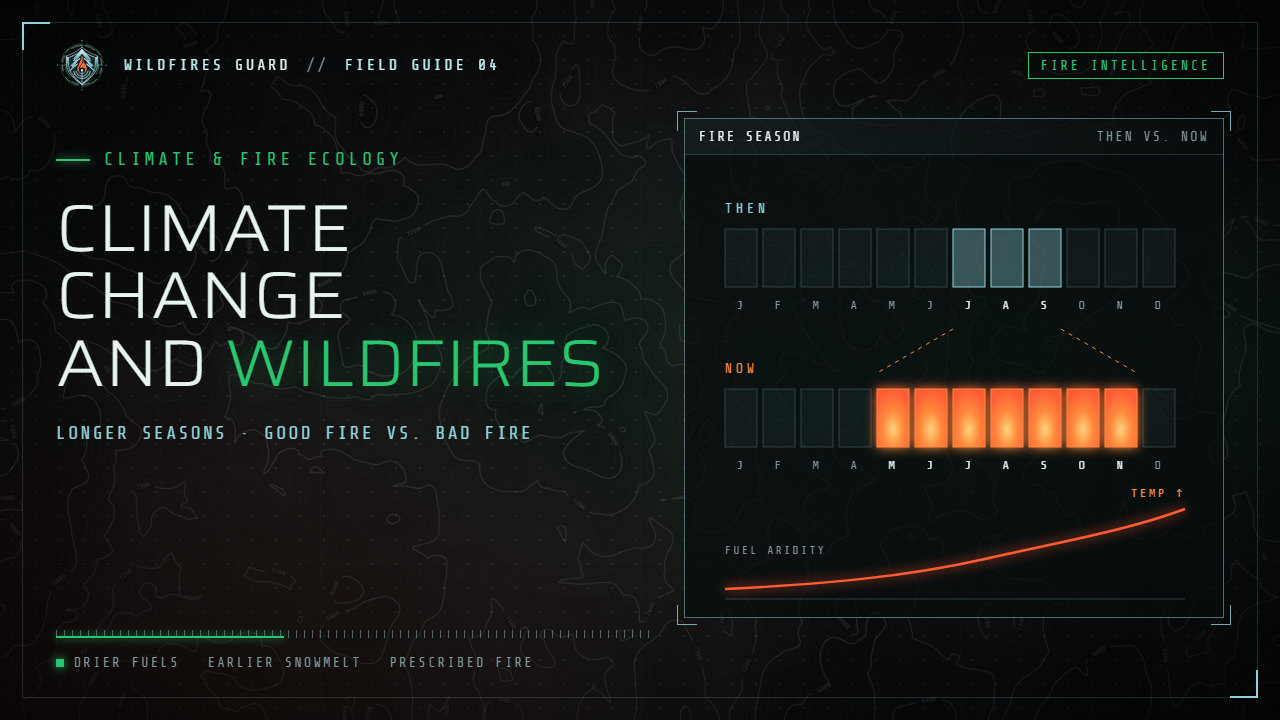
Mountain snowpack acts as a slow-release water supply through spring and summer. When it melts earlier, forests dry out earlier, and the fire season starts sooner and ends later. A landmark 2006 study found that the Western US fire season had grown by 78 days since the 1970s, a change linked to warmer springs and earlier snowmelt. Globally, the length of the fire weather season increased by 18.7% between 1979 and 2013.
Nights matter too. Fire crews have long relied on cool, humid nights to slow fires and give them a chance to make progress. Warmer, drier nights mean more fires keep burning actively around the clock.
Megadrought
Southwestern North America has been in a megadrought since 2000. Research using tree rings found that 2000–2021 was the driest 22-year period in the region in at least 1,200 years, and that human-caused warming made it significantly worse. Drought kills trees, and dead trees become fuel, while drought-stressed living trees carry less moisture and burn more readily.
Weather extremes swing both ways
Wet years are part of the problem too. Heavy winter rains grow a dense crop of grass and brush; when a hot, dry summer follows, that growth cures into fine fuel that carries fire quickly. Scientists call these rapid shifts from wet to dry whiplash, and a warming climate makes them more frequent.
A century of fuel accumulation
Climate is only half the story. The other half is a century-old policy decision.
After the "Big Burn" of 1910 scorched about 3 million acres of Idaho and Montana in two days, the US Forest Service committed to stopping every fire. In 1935 it adopted the "10 a.m. policy": every fire was to be controlled by 10 a.m. the morning after it was reported. Smokey Bear arrived in 1944. Fire suppression worked, in the short term.
But many Western forests evolved with frequent fire. Dry ponderosa pine forests, for example, historically burned every few years to every couple of decades in low-intensity ground fires that cleared brush and small trees while sparing the large, thick-barked pines. Remove that fire for a century and the understory fills in. Today many of these forests hold several times as many trees as they once did, with dense thickets of small trees and dead wood acting as ladder fuels that carry flames into the crowns of the big trees.
The result is a mismatch: forests built for frequent, gentle fire now carry fuel loads that produce rare, extreme fire, in a climate that dries that fuel more every decade.
More homes in harm's way
Meanwhile, more people live in the wildland-urban interface (WUI), where homes meet or mix with wildland vegetation. It is one of the fastest-growing land-use types in the US. More homes in fire-prone areas means more potential ignitions, and much more at stake when a fire starts.
Good fire vs. bad fire
Fire is not inherently destructive. In many ecosystems it is as essential as rain. "Good fire" is low to moderate in intensity, burns mainly along the ground, and renews the landscape. "Bad fire" burns so hot and so widely that it kills mature trees, sterilizes soil, and destroys homes.
| Good fire | Bad fire | |
|---|---|---|
| Intensity | Low to moderate, mostly on the ground | High, often running through tree crowns |
| Effect on mature trees | Most survive | Many killed |
| Soil | Nutrients recycled | Can be scorched, prone to erosion and debris flows |
| Timing | Chosen, under planned conditions | Driven by drought and wind |
| Smoke | Smaller, shorter, can be managed | Heavy, prolonged and widespread |
Why fire is ecologically necessary
- It recycles nutrients locked in dead plant material back into the soil.
- It triggers regeneration. Lodgepole pine and some other species have serotinous cones sealed with resin that open in the heat of a fire. Giant sequoias rely on fire to open their cones and to clear the ground so seedlings can take root.
- It maintains habitat. Grasslands, oak woodlands and the longleaf pine savannas of the Southeast depend on frequent fire to stop them turning into dense thickets.
- It limits future fires by consuming the fuel that would otherwise build up.
Even fire-adapted species have limits. In 2020, the high-severity Castle Fire killed an estimated 10 to 14 percent of all the world's large giant sequoias: trees that had survived dozens of fires over thousands of years but not one burning through a century of accumulated fuel.
Prescribed burn vs. wildfire
A prescribed burn (also called a controlled burn) is a fire set on purpose by trained crews to meet specific goals: reducing fuel, restoring habitat, or protecting communities. The difference between a prescribed burn and a wildfire is control:
- Planning: every prescribed burn follows a written burn plan that defines the area, the goals, the crews and equipment needed, and contingency plans.
- The prescription: the burn goes ahead only within a defined window of temperature, humidity, wind and fuel moisture. If the weather is outside the prescription, it is postponed.
- Containment: crews prepare control lines in advance and stay to patrol and mop up afterwards.
- Smoke management: burns are timed for weather that carries smoke away from communities.
Prescribed fire is most effective combined with mechanical thinning, in which crews first remove small trees and brush, and then repeated every few years to keep fuels down. Studies of fires that ran into treated areas consistently find they burn with lower severity there, giving firefighters places to make a stand.
Fire is also an ancient land-management tool. Indigenous peoples across North America used cultural burning for thousands of years to manage food plants, wildlife habitat and fuels, and tribes are increasingly leading the revival of good fire today.
The risks, honestly
Prescribed fire is not risk-free. In 2022, two prescribed burns in New Mexico escaped and merged into the Hermits Peak/Calf Canyon Fire, the largest wildfire in the state's history. A subsequent Forest Service review found that escapes like this are very rare (the agency reported that about 99.84% of its prescribed fires go as planned) but led to stricter planning and weather checks. Weighed against the alternative, of fuels that keep accumulating until a wildfire burns them on the worst possible day, most fire scientists see prescribed fire as essential.
Fire season trends: what comes next
The trends point one way. More days of high fire weather, drier fuels, and more people in fire-prone areas mean more fires that escape initial attack. Agencies are responding: the US Forest Service's 2022 wildfire crisis strategy aims to treat up to an additional 20 million acres of National Forest land, and up to 30 million acres of other lands, with thinning and prescribed fire over ten years.
Fuel treatments take decades to catch up. In the meantime, the most powerful variable left is time: how quickly a fire is found and how well responders can predict where it will go. That is what Wildfires Guard is working on. The WG Sentinel, now in development, is designed to detect ignitions within seconds, and our predictive intelligence work aims to model how a fire will spread using live wind, terrain and fuel data. It could also help land managers watch over prescribed burns as they happen.
For the human side of a longer fire season, read our guides to preparing your home for wildfire and protecting your lungs from wildfire smoke.
Frequently asked questions
Does climate change cause wildfires?
Not directly. Fires are ignited by people or lightning. Climate change makes the conditions for fire more common and more extreme: hotter temperatures, drier fuels, earlier snowmelt and longer fire seasons. That makes ignitions more likely to grow into large fires.
Why are wildfires getting worse?
Three reasons combine: a warming climate that dries out vegetation, an accumulation of fuel after a century of fire suppression, and the growth of homes and infrastructure in fire-prone areas, which adds ignitions and raises the stakes.
What is the difference between a prescribed burn and a wildfire?
A prescribed burn is planned, set on purpose under specific weather conditions, and managed by trained crews to reduce fuel and restore ecosystems. A wildfire is unplanned, and burns under whatever conditions exist, often the most dangerous ones.
Are prescribed burns safe?
Overwhelmingly, yes: the vast majority go as planned. Escapes are rare but serious, so burns follow strict plans and are postponed when conditions are outside the prescription. Their smoke is usually far less than the smoke from a wildfire burning the same fuel.