Wildfire Preparedness Checklist: How to Protect Your Home and Evacuate Safely
A step-by-step wildfire preparedness checklist for homeowners: create defensible space zones, harden your home against embers, pack a go-bag, and plan your evacuation before the alert.
Most homes lost to wildfire don't burn because a wall of flame rolls over them. They burn because embers, burning pieces of bark and leaves carried by the wind, sometimes a mile or more ahead of the fire, land in a gutter full of leaves, a bark-mulch bed or an open vent. That is good news, because embers can be planned for. This wildfire preparedness checklist walks through the steps, in order of impact, that give your home and family the best odds: defensible space, a hardened house, a packed go-bag, and an evacuation plan you have practiced before the alert arrives.
Wildfire preparedness checklist at a glance
- Start closest to the house: the first 5 feet around it should contain nothing that can burn.
- Manage vegetation in defensible space zones out to 100 feet, or to your property line.
- Harden the house against embers: a Class A roof, ember-resistant vents, clean gutters and enclosed eaves.
- Pack a go-bag for every person and pet, and plan two ways out of your neighborhood.
- Sign up for local emergency alerts now, and leave early. Don't wait for an order if you feel unsafe.
Step 1: Create defensible space zones
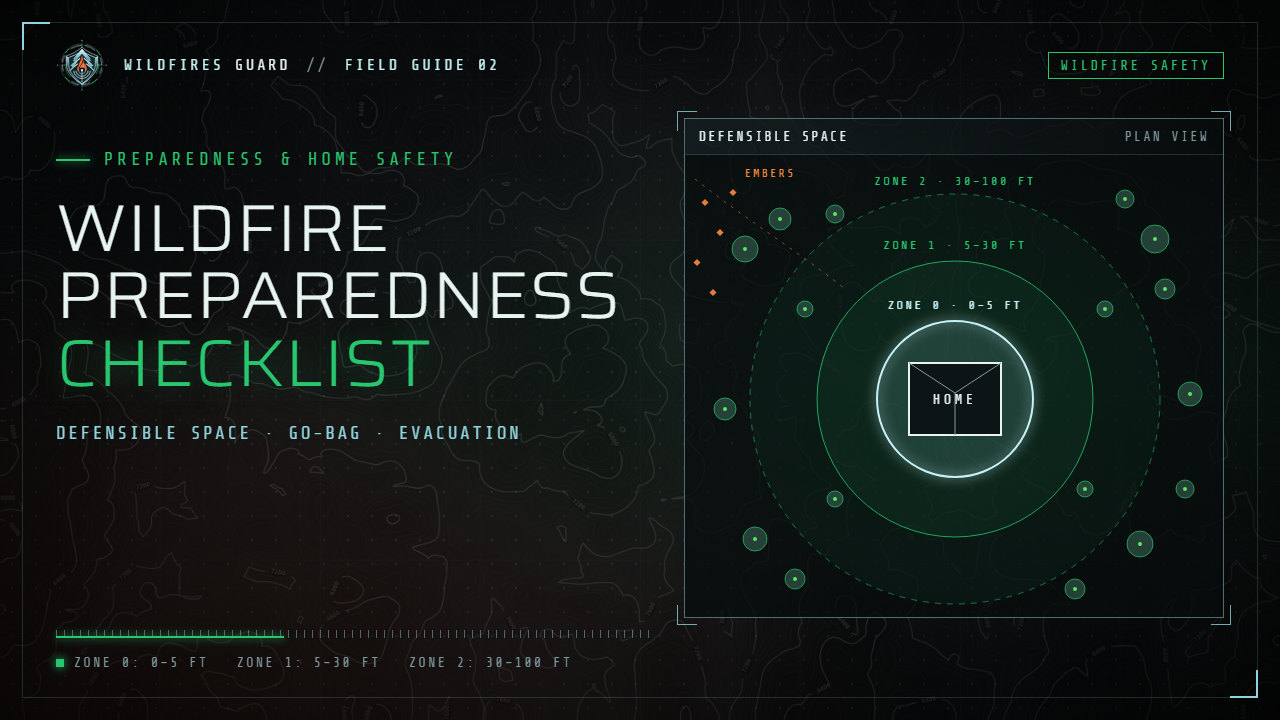
Defensible space is the buffer you create between your home and the vegetation around it. It slows a fire down, keeps flames from reaching the house, and gives firefighters a safe place to work. Fire agencies such as CAL FIRE divide it into three zones, measured from the outer walls of the house and any attached deck.
| Zone | Distance | Goal |
|---|---|---|
| Zone 0: ember-resistant zone | 0–5 ft | Nothing that can catch an ember |
| Zone 1: lean, clean and green | 5–30 ft | Well-spaced, well-watered plants, no dead material |
| Zone 2: reduced fuel zone | 30–100 ft | Break up continuous fuel so fire stays small and on the ground |
Zone 0 (0–5 feet): the ember-resistant zone
This is the most important zone, and the one most often overlooked. Embers that land here ignite whatever they find right against your walls.
- Replace bark mulch and wood chips with gravel, pavers, stone or bare soil.
- Remove dead plants, weeds, leaves and pine needles, including from under decks and stairs.
- Move firewood, lumber, propane tanks, trash bins and patio cushions away from the house.
- Avoid shrubs under windows, and trim back branches that overhang the roof.
- Where a wooden fence or gate meets the house, replace the last five feet with metal or masonry.
Zone 1 (5–30 feet): lean, clean and green
- Keep plants watered and healthy, and remove all dead vegetation.
- Space shrubs and trees so their crowns don't touch, and keep branches at least 10 feet from your chimney.
- Prune tree limbs well up off the ground (6 to 10 feet is a common rule) so a ground fire can't climb into the canopy.
- Move woodpiles and storage sheds out to Zone 2.
Zone 2 (30–100 feet): the reduced fuel zone
- Mow annual grasses to a maximum height of 4 inches.
- Create horizontal space between shrubs and trees, and vertical space between them, by removing ladder fuels: low branches and brush that let fire climb.
- Remove fallen branches, but leave a thin layer of leaf litter to protect the soil from erosion.
- On slopes, increase the spacing: fire spreads faster uphill.
Fire-resistant landscaping
No plant is fireproof, but fire-resistant landscaping buys time. Choose plants with high moisture content, low sap or resin, and an open structure, such as many succulents, deciduous trees and low-growing groundcovers. Keep highly flammable plants such as juniper, arborvitae, cypress and tall ornamental grasses away from the house. Maintenance matters more than species: a well-watered, pruned shrub is far safer than a "fire-resistant" one that has been left to dry out.
Step 2: Harden your home against embers
Defensible space protects the house from flames. Home hardening protects it from embers. Work through the house from the top down:
- Roof: the most vulnerable part of a home. A Class A fire-rated roof (composition shingle, metal, clay or concrete tile) is the standard. Plug gaps under roof tiles at the edges so birds' nests and debris can't collect.
- Vents: attic, foundation and crawlspace vents are open doors for embers. Cover them with 1/16- to 1/8-inch metal mesh, or install ember-resistant vents (often labeled WUI vents).
- Gutters: clean them regularly and fit noncombustible gutter guards. A gutter full of dry needles is a fuse running along your roof line.
- Eaves and soffits: enclose open eaves with ignition-resistant or noncombustible materials.
- Windows: heat can break glass before the house ignites, letting embers inside. Dual-pane windows with at least one pane of tempered glass are far more resistant.
- Walls: use ignition-resistant siding such as stucco, fiber cement or treated wood, and keep 6 inches of noncombustible clearance at the base of exterior walls.
- Decks: build or resurface with ignition-resistant materials, keep the area underneath clear, or enclose it with metal mesh.
- Chimney and garage: fit a spark arrestor on the chimney, and seal gaps around the garage door with weatherstripping.
Hardening is an investment, so prioritize: clear Zone 0, clean the roof and gutters, and screen the vents first. Those three steps are cheap and address the most common ways homes ignite.
Step 3: Pack a wildfire go-bag
When an evacuation order comes, you may have minutes. Keep a go-bag for each family member ready by the door or in the car. Ready.gov recommends at least three days of supplies.
- Water (one gallon per person per day) and nonperishable food
- Prescription medications, glasses and medical devices
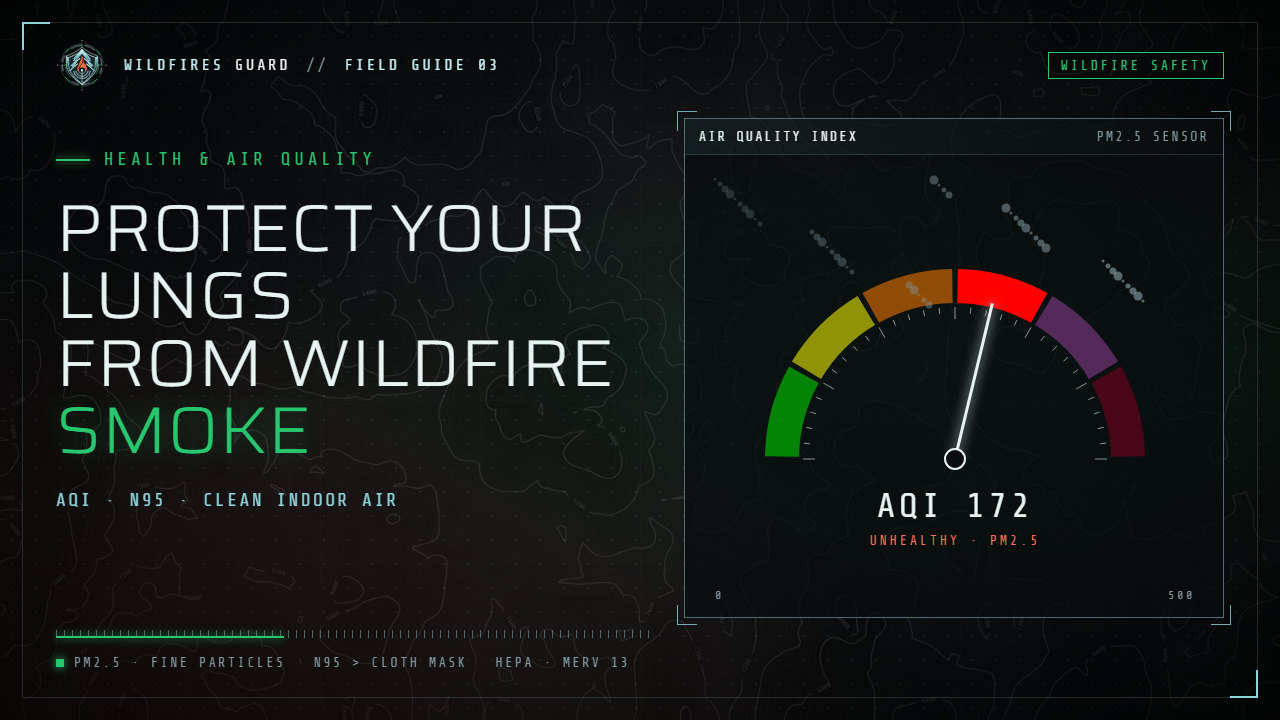
- N95 respirators for every adult, to protect against smoke (see our guide to protecting your lungs from wildfire smoke)
- First aid kit, flashlight, battery or hand-crank radio, extra batteries and phone chargers
- Copies of important documents (IDs, insurance policies, deeds, medical records), stored digitally as well
- Cash, credit cards and a list of emergency contacts on paper
- A change of clothes, sturdy shoes, goggles and a printed map of local routes
- Food, water, leashes, carriers and records for pets
Firefighters often summarize what to take as the six P's: people and pets; papers, phone numbers and important documents; prescriptions, vitamins and eyeglasses; pictures and irreplaceable memorabilia; personal computer hard drive and disks; and "plastic" (credit cards, ATM cards) and cash.
Before fire season, walk through your home with your phone and record a video inventory of your belongings. It makes insurance claims far easier.
Step 4: Build a wildfire evacuation plan
Evacuation plans fail when they are improvised. Work through these steps with your household before fire season, using the Ready, Set, Go! approach many fire departments teach:
- Sign up for alerts. Register for your county's emergency notification system, keep Wireless Emergency Alerts switched on on your phone, and find out whether your area uses numbered evacuation zones. Know your zone.
- Map two routes out. Fires close roads. Know at least two ways out of your neighborhood, and drive them.
- Pick meeting points. Choose one place near home and one outside the area, and an out-of-area contact everyone can call or text.
- Plan for everyone. Arrange help for neighbors, older relatives or anyone without a car, and decide how you'll move pets and livestock.
- Practice. Run a drill and time how long it takes to load the car.
Know the evacuation levels
Many areas use a three-level system, though the names vary:
- Ready (Level 1): be aware of the danger, and prepare your go-bag and home.
- Set (Level 2), often an Evacuation Warning: be ready to leave at a moment's notice. Leave now if you need extra time, have pets or livestock, or feel unsafe.
- Go (Level 3), an Evacuation Order: leave immediately.
Leaving early is always safer. Smoke, traffic and fire can close roads within minutes, and many wildfire deaths happen to people caught on the road during a late evacuation.
If you have time before you leave
- Close all windows and doors, but leave them unlocked, and close interior doors.
- Remove flammable curtains, and move furniture away from windows to the center of rooms.
- Shut off gas at the meter and turn off pilot lights.
- Bring patio furniture and doormats inside, and connect garden hoses so firefighters can use them.
- Leave exterior lights on so the house is visible in smoke.
- Back your car into the driveway, loaded, with the windows closed.
Stay informed during fire season
Preparedness doesn't stop once the plan is written. On high-risk days, when the National Weather Service issues a Red Flag Warning, put the go-bags in the car and keep an eye on real-time wildfire maps and alert tools. And because most fires are started by people, every household that follows basic wildfire prevention habits lowers the risk for its neighbors too.
The earlier a fire is detected, the more time everyone has to act. Wildfires Guard is developing the WG Sentinel, designed to detect ignitions within seconds and give fire departments a forecast of where the fire will spread, so that warnings could reach communities while there is still time to leave calmly. It is not in service yet, so keep following your local alerts. If you manage land or a community that needs earlier warning, talk to us about a pilot.
Frequently asked questions
How far should defensible space extend from my house?
At least 100 feet from the house, or to your property line if it's closer. Steep slopes and heavy fuel may call for more. The first 5 feet (Zone 0) matter most.
What is the most important thing I can do to protect my home from wildfire?
Remove everything that can burn within 5 feet of the house, and keep the roof and gutters clear of debris. Most homes ignite from embers landing in exactly those places.
What should be in a wildfire go-bag?
Water, food, medications, N95 respirators, a first aid kit, a flashlight and radio, chargers, copies of important documents, cash, clothing, and supplies for pets. Pack enough for at least three days.
When should I evacuate from a wildfire?
As soon as you feel unsafe, and immediately when an evacuation order is issued. Don't wait for an order if you have pets, livestock or mobility needs: leaving at the evacuation-warning stage is safer.