What Causes Wildfires? 10 Leading Triggers and How to Prevent Them
Nearly 85% of US wildfires are started by people. Learn how the fire triangle works, the 10 most common causes of wildfires, and the prevention habits that stop them.
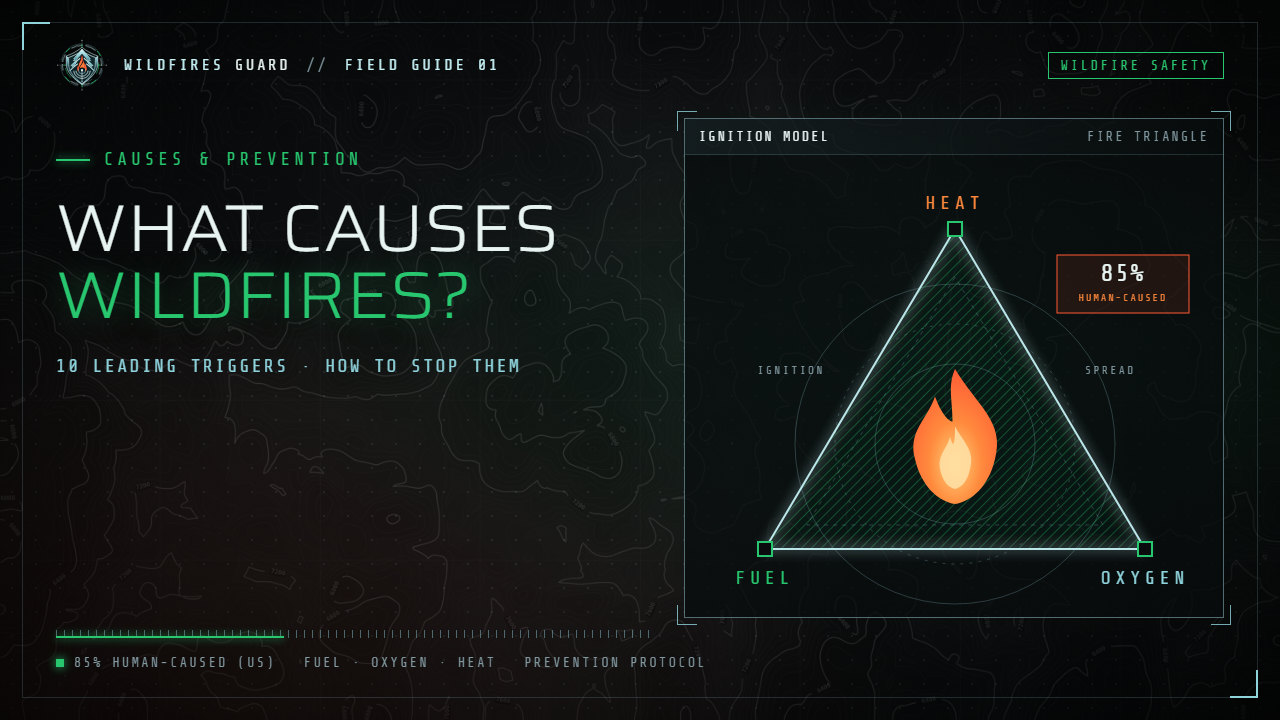
What causes wildfires? Every wildfire needs three things at the same moment: something to burn, oxygen to feed it, and a source of heat to start it. Nature supplies the first two in abundance. The third, the spark, is where people come in: in the United States, nearly 85% of wildland fires are started by humans. That makes most wildfires preventable, if you know how they start.
This guide explains how wildfires start, ranks the 10 leading triggers, and closes with the prevention habits that matter most for campers, homeowners and travelers.
Key takeaways
- A fire needs fuel, oxygen and heat. Take away any one of the three and it goes out.
- About 85% of US wildfires are human-caused: debris burning, campfires, equipment, vehicles, power lines, cigarettes, fireworks and arson.
- Lightning is the main natural cause. It starts fewer fires, but often in remote places where they grow large before anyone sees them.
- Most prevention is simple: check fire restrictions, drown campfires, keep sparks away from dry grass, and never burn on dry, windy days.
How do wildfires start? The fire triangle
Firefighters describe combustion with the fire triangle. A wildfire starts, and keeps burning, only while all three sides are present:
- Fuel: anything that can burn. In the wild that means dry grass, leaf litter, pine needles, shrubs, dead branches and trees, but also fences, decks and homes. Fine, dry fuels such as cured grass ignite the fastest.
- Oxygen: about 21% of the air we breathe. Wind matters because it pushes fresh oxygen into the fire and bends flames toward unburned fuel, which is why fires spread fastest on windy days.
- Heat: the ignition source that raises fuel to its ignition temperature. This is a lightning strike, an ember, a spark from a mower blade, a hot exhaust pipe or a match.
Weather and terrain decide what happens next. Hot, dry and windy conditions dry out fuels and drive flames forward, and fire runs uphill much faster than downhill because the flames preheat the fuel above them. Firefighters call this trio fuel, weather and topography, the fire behavior triangle.
Prevention works on the heat side of the triangle. You can't remove oxygen from a forest, and you can only reduce fuel, but you can control almost every human source of ignition.
Natural vs. human causes of wildfires
Researchers who analyzed more than 1.5 million US wildfire records found that humans ignited 84% of wildfires between 1992 and 2012, and that human ignitions tripled the length of the fire season compared with lightning alone. People start fires in places and seasons where lightning rarely does: in early spring, late autumn, along roads and near homes.
Lightning fires are fewer but often larger. They tend to start in remote, rugged country, sometimes several at once from a single storm, and can burn for hours before anyone reports them. California's 2020 August Complex, the state's first fire to exceed a million acres, began as dozens of lightning ignitions.
What causes wildfires? The 10 leading triggers
Fire investigators sort ignitions into standard cause categories. These are the ten that start the most fires, roughly ordered by how common they are across the US. The ranking differs by region: debris burning dominates in the East and South, while lightning, equipment and power lines matter more in the West.
1. Debris and yard-waste burning
Burning leaves, brush and trash is one of the most common causes of wildfires in the country. Piles that seem fully out can smolder for days and flare up when the wind rises, and a single gust can carry embers into dry grass nearby.
2. Campfires
An abandoned or poorly extinguished campfire can sit in the ashes for hours before the wind revives it. Campfires built outside established fire rings, or on windy days, are the riskiest.
3. Equipment and machinery
Lawn mowers, chainsaws, string trimmers, welders and grinders all throw sparks or carry hot surfaces. A mower blade striking a rock in dry grass is enough. Agricultural machinery and off-road vehicles without working spark arrestors are frequent culprits.
4. Vehicles and roadside sparks
Hot exhaust systems and catalytic converters can ignite grass when a car parks or pulls over on a dry verge. Trailer safety chains dragging on the pavement throw a stream of sparks, and so does a wheel rim running on a flat tire: California's 2018 Carr Fire started exactly that way.
5. Power lines and electrical infrastructure
Wind can bring lines into contact with trees or with each other, and failing equipment can drop molten metal into dry vegetation. These fires are especially dangerous because the same high winds that cause the failure drive the fire. The 2018 Camp Fire, started by a utility transmission line, killed 85 people and destroyed nearly 19,000 structures in and around Paradise, California.
6. Cigarettes and smoking
A cigarette tossed from a car window or dropped on a trail can ignite dry grass, peat or duff, especially on low-humidity days.
7. Fireworks and pyrotechnics
Fireworks start thousands of fires every year around holidays, and pyrotechnic devices at outdoor celebrations have triggered major wildfires. Most fire-prone areas ban consumer fireworks during fire season for this reason.
8. Arson
Some fires are set deliberately. Arson fires are often started near roads, in multiple places, or during the most dangerous weather, which makes them especially hard to contain.
9. Railroads
Brake shoes, wheel friction and exhaust particles from locomotives can ignite vegetation along the tracks, sometimes starting several fires in a row along a rail line.
10. Lightning
The leading natural cause. "Dry lightning", from storms that produce little rain that reaches the ground, is the most dangerous, because strikes land on dry fuel without any rain to dampen it.
| Cause | Type | Typical setting |
|---|---|---|
| Debris burning | Human | Rural properties, spring and autumn |
| Campfires | Human | Parks, forests and dispersed camping |
| Equipment use | Human | Yards, farms, construction sites |
| Vehicles | Human | Roadsides and pull-outs |
| Power lines | Human (infrastructure) | Windy days, wooded corridors |
| Smoking | Human | Roads and trails |
| Fireworks | Human | Holidays and celebrations |
| Arson | Human | Near roads, in peak fire weather |
| Railroads | Human | Along tracks |
| Lightning | Natural | Remote, high terrain in summer storms |
Wildfire prevention tips that actually work
Because most fires start with people, most prevention comes down to a few habits. Before you do anything that could make a spark, check your local fire danger rating and any burn bans or fire restrictions in force. Restrictions change quickly in fire season.
For campers and hikers
- Build campfires only where they're allowed, in an established fire ring, away from overhanging branches, and never on a windy day.
- Keep the fire small, and keep water and a shovel next to it.
- Never leave a campfire unattended, even for a few minutes.
- Put it out with the Drown, Stir and Feel method: drown it with water, stir the ashes, drown it again, then feel for heat with the back of your hand. If it's too hot to touch, it's too hot to leave.
- Use a camp stove instead of an open fire when restrictions are in place.
For homeowners
- Get a permit and check the forecast before burning debris, and don't burn on dry or windy days. Composting or chipping yard waste avoids the risk entirely.
- Mow and use power tools in the cool, humid morning, not in the heat of the afternoon, and stop if the wind picks up.
- Keep spark arrestors on chainsaws, trimmers and off-road vehicles in good repair.
- Dispose of fireplace and grill ashes in a metal can with a lid, wetted down, away from the house.
- Report utility lines tangled in trees to your power company.
- Go further and protect the house itself with our wildfire preparedness checklist and defensible space guide.
For drivers and travelers
- Never park or idle on dry grass: the exhaust system is hot enough to ignite it.
- Secure trailer safety chains so they can't drag, and check tire pressure and bearings before towing.
- Maintain your vehicle; a worn brake or a loose exhaust part can throw sparks.
- Use your ashtray. Never throw cigarettes out of the window.
- Leave fireworks at home when you travel to fire-prone areas.
If you see smoke or flames
Call 911 immediately and give the clearest location you can: road names, mile markers, landmarks or GPS coordinates. Don't assume someone else has reported it. In the first minutes a fire can still be stopped by a single engine crew. To keep track of fires already burning around you, see our guide to real-time wildfire maps and trackers.
Why the first minutes matter
Prevention reduces how many fires start, but it will never stop them all, and lightning will always be with us. Once a fire starts, the outcome depends on how fast it is found. A fire reported while it is still the size of a room is a routine call; the same fire found an hour later on a windy afternoon can become a disaster. And as climate change lengthens fire seasons, there are more days when an ignition can run.
That gap between ignition and detection is the problem Wildfires Guard is built to close. The WG Sentinel, now in development, is designed to watch the forest continuously with optical, thermal and air-chemistry sensors, confirm a fire within seconds, and send fire departments its location along with a forecast of where it will spread.
Frequently asked questions
What is the number one cause of wildfires?
People. About 85% of wildfires in the US are human-caused. Among individual causes, debris burning is one of the most common nationally, while lightning is the leading natural cause and the main cause of the largest fires in the remote West.
Can wildfires start on their own?
Not without a heat source. Lightning is the only common natural ignition source. Spontaneous combustion of materials such as damp hay or oily rags does happen, but it rarely starts a wildfire. Volcanic activity is a cause only in a few places.
Why are so many wildfires human-caused?
Because people live, work, drive and play in fire-prone landscapes all year round. Every road, power line, campsite and backyard is a potential ignition point, and human-caused fires happen in seasons when lightning rarely strikes.
What time of year do most wildfires start?
That depends on the region. In the West, fire season peaks in summer and autumn, when fuels are driest and winds strongest. In the Southeast and Plains, spring and late winter are peak times, when dead grass is dry before green-up. Fire seasons are getting longer in many regions.